Disclosure: ShoeTest is independent and is not Birchbury’s official website. Some links are affiliate links — if you buy through them we may earn a commission at no extra cost to you. Prices and specs were checked on official brand pages in September 2026 and can change.
Key takeaways
- A wide toe box means the front of the shoe is shaped like a foot — widest at the toes — not just “wide width.”
- If your toes touch or overlap the sides of your shoe, or you see redness on your little toe after a day, your current shoes are probably too narrow at the front.
- Do the 2-minute trace test before buying anything.
- Change gradually: most wide toe box shoes are also zero drop, and calves need time to adapt.
- Everyday pick: Birchbury Bramford. Dressy pick: Birchbury Brenston. Boot pick: Birchbury Carnforth.
What is a wide toe box?
The toe box is the front part of a shoe that surrounds your toes. In most conventional shoes it tapers: the shoe is widest around the ball of the foot and then narrows toward a point. Your toes, however, are usually widest at the tips when they’re relaxed and spread.
A wide toe box (also called a foot-shaped, anatomical or natural toe box) follows your foot’s outline instead. The big toe can point straight ahead rather than being pushed inward, and the small toes aren’t pressed against each other.
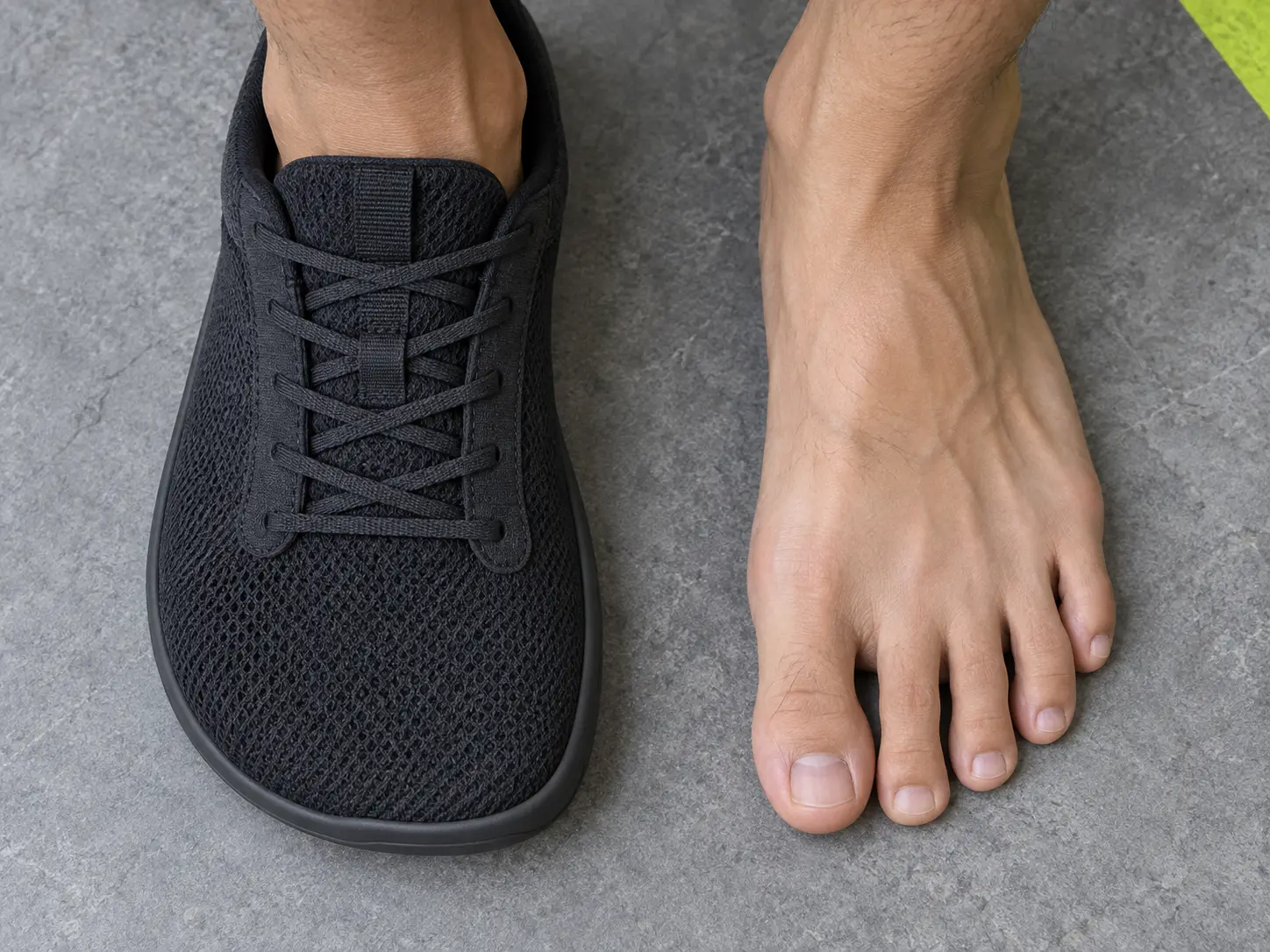
Wide toe box vs. wide width: not the same thing
This is the most common buying mistake. A “wide” or “2E/4E” size from a conventional brand usually makes the whole shoe roomier — including the heel and midfoot — but often keeps the same tapered toe shape. You can end up with a sloppy heel and toes that are still squeezed.
| Wide width (E, 2E, 4E) | Wide toe box | |
|---|---|---|
| What changes | Overall volume of the shoe | The shape of the front |
| Toe shape | Usually still tapered | Foot-shaped, widest at toes |
| Heel fit | Can become loose | Normal heel, roomy front |
| Best for | High-volume or broad feet overall | Toes that feel cramped or pushed together |
Some people need both. But if your main complaint is toes, shape matters more than size.
Who might benefit from a wide toe box?
You’re a good candidate if you recognise any of these:
- Your toes feel squeezed or numb by the end of the day.
- You get rubbing, redness or corns on the outside of the little toe or the inside of the big toe.
- You take your shoes off under the desk whenever you can.
- Your feet are simply wider at the front than most shoes.
- You stand or walk for long hours and want your toes to help with balance.
The 2-minute trace test (do this before buying)
You don’t need a store or a special device to see whether your shoes fit your toes.
- Test at the end of the day, when feet are at their largest.
- Stand on a sheet of paper with your weight evenly on both feet.
- Trace around one foot with a pen held straight up and down.
- Take out your current shoe’s insole and place it on top of the tracing.
- Look at the toes. If your toe outline spills past the insole’s edges, the shoe is too narrow at the front — no matter what the size label says.
- Check length too: you want roughly a thumb’s width (about 1–1.5 cm) beyond your longest toe.
Keep the tracing. When shopping online, compare it with brand size charts, and use free returns to confirm fit at home on a clean floor.
What to look for in wide toe box shoes
Shape: a straight inner edge
Look at the sole from underneath. A good foot-shaped shoe has a fairly straight line along the big-toe side, rather than curving inward.
Zero drop (or close to it)
Most foot-shaped shoes are also zero drop. Pairing a roomy toe box with a flat platform keeps your weight from sliding forward and jamming toes into the front.
A secure midfoot and heel
Roomy toes shouldn’t mean a loose shoe. Laces, elastic laces or a snug heel counter should hold your foot so it doesn’t slide forward.
The right amount of sole
Ultra-thin soles give maximum ground feel but can be tough if you’re new or stand on concrete. Transitional shoes with a removable cushioned insole let you start comfortable and go thinner later.
A style you’ll actually wear
The best shoe is the one you wear every day. Historically, wide toe box shoes looked athletic or orthopedic; newer brands focus on leather sneakers, dress shoes and boots.
Best wide toe box shoes by occasion
Everyday: Birchbury Bramford

A minimal full-grain leather sneaker with an anatomical wide toe box, zero-drop sole, elastic no-tie laces and a removable cushioned insole. It comes in seven colorways, including a non-slip black. From $99, rated 4.6/5 from 1,159 reviews on Birchbury’s site. It’s the easiest way to try a wide toe box without looking like you’re wearing “special shoes.” Check Bramford price ↗
Office and formal: Birchbury Brenston
Wide toe box dress shoes are rare because a tapered toe is part of classic formal style. The Brenston keeps a roomy front and flat footbed but adds a faux heel on the outside so the silhouette looks like a traditional dress shoe. Non-slip sole on every colorway, $180, 4.5/5 from 667 reviews. See Brenston ↗ For more formal options, see our barefoot dress shoes comparison.
Boots and bad weather: Birchbury Carnforth

A chukka boot with the same wide toe box, water-resistant leather or suede, and a non-slip outsole. Currently $197 (regular $240). A good choice if cold, wet commutes are what keep you in narrow, stiff boots. See Carnforth ↗
All three sit on the same wide-toe platform — compare them on Birchbury ↗ or see how they look on real feet in customer photos ↗.
Other brands worth knowing
| Shoe | Category | Price | Why consider it |
|---|---|---|---|
| Lems Primal Zen | Casual sneaker | $120 | Beginner-friendly 9.5mm stack |
| Vivobarefoot Primus Lite IV | Training / city | $125 | Thin 5.5mm stack for gym and walking |
| Merrell Vapor Glove 7 | Light athletic | $110 | Light, grippy on wet surfaces |
| Xero Shoes Glenn | Dress-casual | $139.99 | 5,000-mile sole warranty |
| Lems Chelsea Waterproof | Boot | $175 | Fully waterproof |
Prices: brand pages and OutdoorGearLab’s barefoot shoe testing (June 2026). Prices change often; check before buying.
How to transition safely
If you’ve spent years in narrow shoes with a raised heel, your feet and lower legs have adapted to that. Moving to a wide toe box, zero-drop shoe is usually comfortable immediately at the toes, but calves, Achilles and arches can feel the change.
- Start with 1–2 hours a day for the first week.
- Keep the cushioned insole in at first, especially on hard floors.
- Add time gradually over 3–4 weeks until you’re wearing them all day.
- Mix in walking barefoot at home to let your feet get used to moving naturally.
- Back off if pain is sharp or lasting, and get professional advice.
Working long shifts? Our best barefoot shoes for work guide covers standing jobs and dress codes, and our Birchbury review goes deeper on sizing for all three models.
Common sizing mistakes to avoid
Buying Birchbury specifically? Their charts and between-sizes rule are model-dependent — we broke them down in the Birchbury sizing guide.
- Sizing down because the shoe “looks big.” Wide toe box shoes look bigger than conventional shoes. Trust your tracing, not the mirror.
- Buying wide width instead of wide toe box. See the comparison above.
- Testing fit in the morning. Feet swell during the day.
- Ignoring brand guidance. Birchbury, for example, advises sizing up if you’re US 11 or smaller and between sizes, and down if you’re US 12+.
- Wearing thick socks at the fitting you won’t wear daily. Try shoes with your normal socks.
Frequently asked questions
What does wide toe box mean?
It means the front of the shoe is shaped like a foot — widest where your toes are — so toes can lie flat and spread instead of being squeezed to a point.
Are wide toe box shoes good for bunions?
Many people with bunions find a roomier toe box more comfortable because there’s less pressure on the joint, but shoes can’t treat bunions. Talk to a podiatrist about your specific situation.
Is wide toe box the same as wide width?
No. Wide width increases the overall volume of a shoe, often keeping a tapered toe. A wide toe box changes the shape of the front to match your foot.
Do wide toe box shoes look strange?
Older designs often did. Newer brands make leather sneakers, dress shoes and boots, such as the Birchbury Bramford, that look close to conventional footwear.
How do I know if my shoes are too narrow?
Trace your foot while standing and place your shoe’s insole on top. If your toes extend past the edges of the insole, the shoe is too narrow at the front.
Should I size up in wide toe box shoes?
Not automatically. Follow the brand’s size chart and your foot tracing. Birchbury recommends sizing up only if you’re US 11 or smaller and between sizes.